| Parameter | Specification |
|---|---|
| Product Name | Matribot Bioprinter |
| Instrument Type | 3D Bioprinter |
| Printing Technology | 3D Bioprinting |
| Material Compatibility | Bioinks, Hydrogels, and Biomaterials |
| Operation | Benchtop |
| Enclosure | Enclosed Printing Chamber |
| Control | Digital Control Interface |
| Applications | Tissue Engineering, Regenerative Medicine, Biomaterial Research, 3D Cell Models, Biotechnology, Biomedical & Research Laboratories |
All
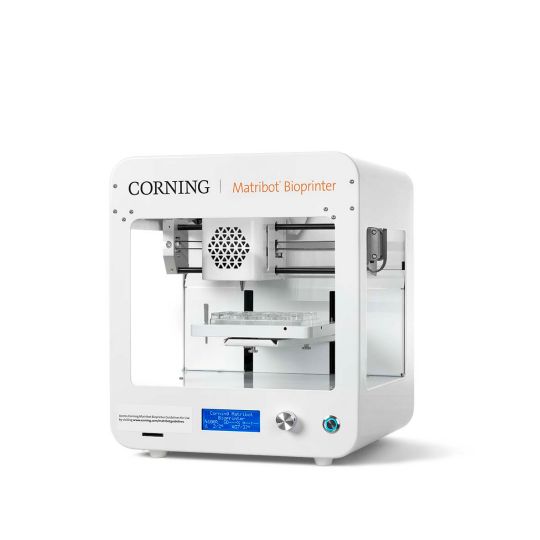
Matribot Bioprinter
The Matribot Bioprinter is a laboratory instrument designed for precise three-dimensional (3D) bioprinting of biomaterials and bioinks for tissue engineering and life science research. It enables controlled deposition of biological materials for advanced biomedical and regenerative medicine applications.
- Designed for precise three-dimensional bioprinting of biological materials.
- Compatible with a variety of bioinks, hydrogels, and biomaterials.
- Supports tissue engineering and regenerative medicine research applications.
- Enclosed printing chamber provides a clean and controlled working environment.
- User-friendly digital controls simplify operation and workflow management.
- Suitable for scaffold fabrication and advanced biomedical research.
- Ideal for biotechnology, pharmaceutical, academic, and life science laboratories.
The Matribot Bioprinter is a benchtop laboratory instrument developed for three-dimensional bioprinting of biomaterials, hydrogels, and bioinks used in tissue engineering and regenerative medicine research. It provides precise and controlled material deposition, allowing researchers to fabricate complex biological structures for experimental and developmental studies. Its enclosed design helps maintain a clean working environment while offering clear visibility of the printing process.
This bioprinter is widely used in biotechnology, biomedical engineering, pharmaceutical research, regenerative medicine, tissue engineering, and academic laboratories. It supports applications such as scaffold fabrication, cell-laden construct development, biomaterial research, and 3D biological model creation. Designed for research environments, the system offers user-friendly operation and reproducible printing performance, making it suitable for laboratories engaged in advanced life science and biomedical research.