
| Specification | Details |
|---|---|
| Product Name | Rotary Vacuum Flash Evaporator AI-13 |
| Category | Analytical Instrument |
| Product Type | Rotary Vacuum Evaporator |
| Display | Digital LCD Display |
| Rotation Speed | Adjustable Variable Speed |
| Heating Bath | Digital Water Bath |
| Temperature Range | Ambient to 180°C (Model Dependent) |
| Condenser Type | Vertical Coil / Double Condenser |
| Vacuum Operation | Compatible with External Vacuum Pump |
| Flask Capacity | Multiple Flask Sizes Supported |
| Construction | Corrosion-Resistant Laboratory-Grade Materials |
| Power Supply | 220–240V AC, 50/60 Hz |
| Application | Solvent Recovery, Distillation & Sample Concentration |
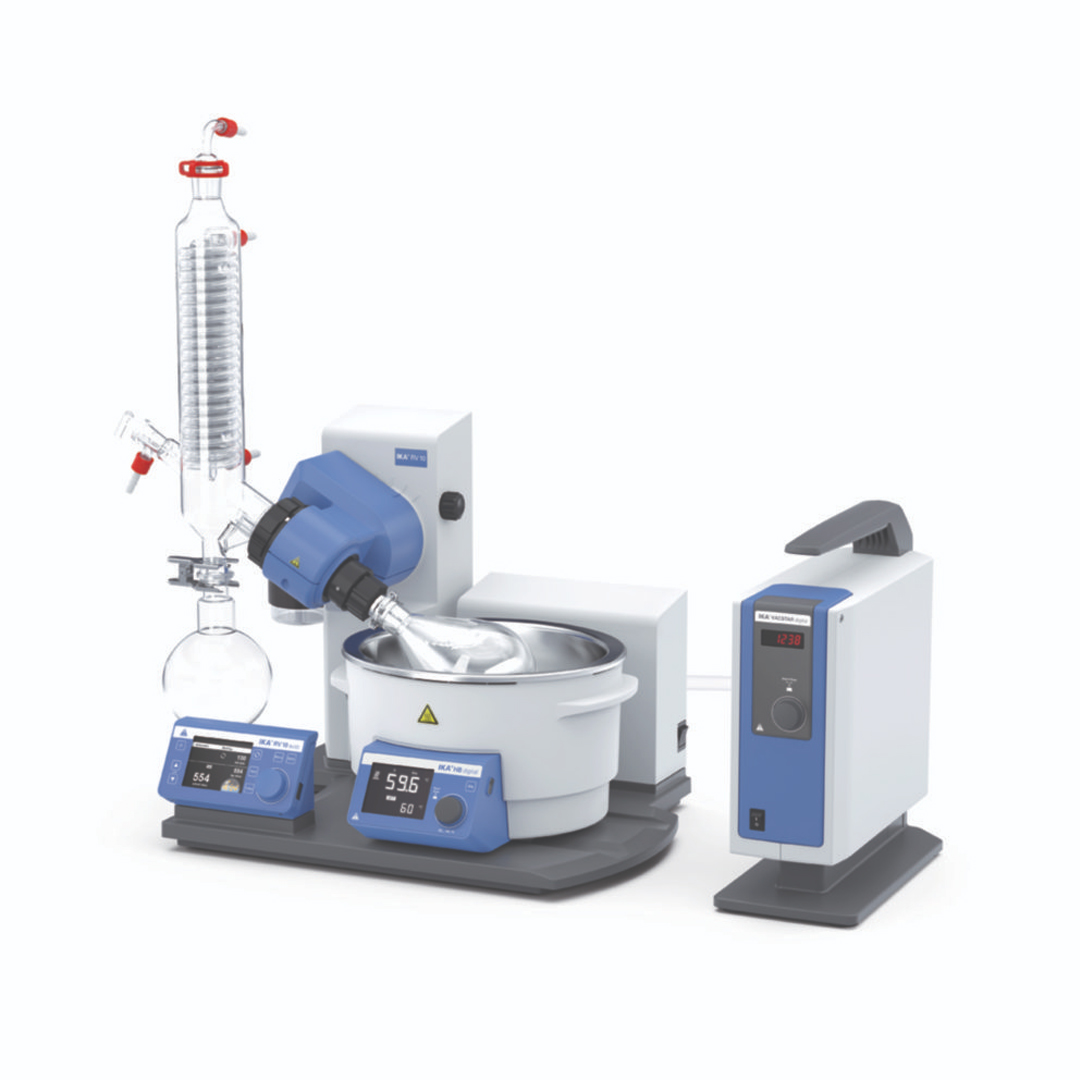
All, Analytical Instrument
Rotary Evaporators Model RV10 Auto Pro V
The Rotary Vacuum Flash Evaporator AI-13 is a high-performance laboratory instrument designed for efficient solvent evaporation, concentration, distillation, and sample recovery under reduced pressure. Equipped with precise temperature control, adjustable rotation speed, and an efficient condenser system, it provides rapid, safe, and reliable evaporation for pharmaceutical, chemical, biotechnology, food, and research laboratory applications.
- Efficient solvent evaporation under reduced pressure.
- Adjustable rotation speed for uniform sample evaporation.
- Digital temperature control ensures precise heating.
- High-efficiency condenser for excellent solvent recovery.
- Vacuum-compatible system for low-temperature evaporation.
- Easy flask lifting mechanism for safe operation.
- Durable laboratory-grade construction for long-term performance.
- User-friendly controls for convenient laboratory operation.
- Ideal for pharmaceutical, chemical, biotechnology, food & beverage, environmental, academic, and research laboratories.
- Suitable for solvent recovery, sample concentration, purification, extraction, and distillation applications.
- Compatible with a wide range of laboratory glassware and vacuum pumps.
- Clean the glass components thoroughly after each operation to prevent contamination.
- Regularly inspect seals, tubing, and vacuum connections for optimum performance.
- Install the instrument on a stable, level laboratory bench in a well-ventilated area.
- Perform routine maintenance and calibration to ensure reliable long-term operation.


